General Information
The unified data entry solution – in a broader sense – is a payment request that is communicated via direct data transfer between the beneficiary and the payer's devices, and contains only data relating to the beneficiary and the transaction, thus containing no data about the payer (the MNB regulation interprets the concept of a payment request more narrowly, as it only considers messages mediated by payment service providers that are standardised in the domestic payment system and contain all data necessary for submitting a transfer).
Based on the data read via the EAM, the payer creates a transfer order on their mobile device by specifying the payment account to be debited, and after verifying the data, within the options offered to them, approves the transfer order with or without modifying or supplementing the order data.
The special procedure applied in the domestic payment system requires authentication of the EAM code, which guarantees that the beneficiary produces the EAM code with the involvement of a payment service provider, conducts genuine economic activity, and that the paid amount is credited to the appropriate payment account, and in case of dispute, the enforcement of consumer rights is also supported by appropriate procedures and commitments.
EAM payment is secure, as the payer does not need to provide personal data for data entry. Order data can only be read into the mobile device – and the mobile application provided by the payment service provider running on it – based on an authenticated code, and the authenticity and appropriateness of the authentication code is also verified by the payer's account-keeping payment service provider.
The speed of EAM payment is guaranteed by the immediate confirmation sent to the acceptance endpoint – confirming that the payment has been executed – which is compiled by the payer's bank and which the Aggregator transforms for the purpose of endpoint notification; thus, the difference between the initiation of payment and the notification of endpoints can be only a few seconds. The payer's account-keeping payment service provider also sends a notification to the acceptance endpoint in the event of the transaction failing for any reason.
The special feature of a transfer order read via EAM is that the beneficiary of the payment is not only the seller of the goods or services, but can also be an acceptance or settlement party (Sub-Aggregator or other intermediary), which forwards the received amount itemised or in batch to the actual beneficiary.
EAM generation can be done in real time based on item-by-item (individual) requests, or in batch form – not in real time.
The Online Payment Site service supports the EAM (instant payment with QR code and/or Deeplink) and payment request payment methods during web purchases.
The Online Payment Site service facilitates the integration of the Raiffeisen PAY service into a website, making QR code payment and Deeplink-initiated payment, as well as payment request available among the unified data entry solutions.
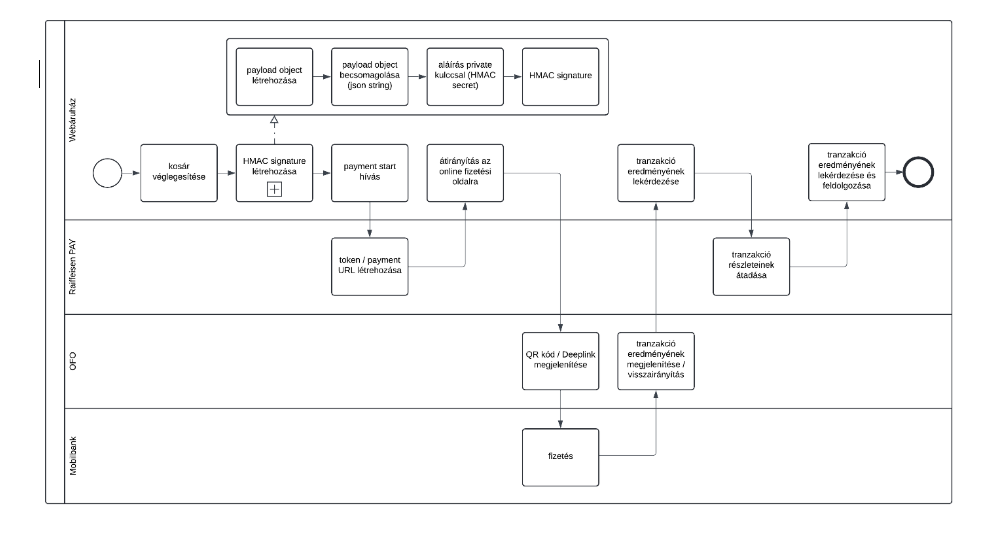
Security and Authentication
The API uses standard REST HTTPS calls during communication, with control information carried in the http header, and the payment information (payload) format is JSON.
The solution used by Raiffeisen PAY APIs:
Protocol: HTTPS
Authentication:
API Key-based, meaning the caller receives it from the bank during registration, and it must be included in the http header of calls
X-API-KEY(its value is received from the Bank after registration on the pay portal)
Application of digital signature for high security
HMAC signature(its value is received from the Bank after registration on the pay portal)
The api-key and HMAC secret values differ between production and test environments.
Base URL
Test environment: https://premium-api-int.raiffeisen.hu
Production environment: https://premium-api.raiffeisen.hu